HD just got cilia
Huntington's disease just got cilia: huntingtin protein affects tiny but important hairs on cells called cilia

A better understanding of the normal role of the huntingtin proteinhuntingtin protein The protein produced by the HD gene. would make developing treatments easier. Surprising new results from French researchers suggest that huntingtin influences tiny hair-like structures called ‘ciliacilia Hair-like protrusions on the surface of cells’. Now we need to figure out what it means for patients.
Who is Ciliacilia Hair-like protrusions on the surface of cells?
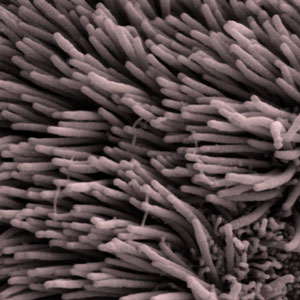
Look at a drop of pond water under a microscope and you’ll see thousands of tiny single-celled animals swimming around. These organisms need to swim towards food and away from predators. They’re coated in rhythmically beating hairs called ciliacilia Hair-like protrusions on the surface of cells that power their movement.

Some human cells have ciliacilia Hair-like protrusions on the surface of cells, too. For example, the air passages of our lungs are lined with cells that have ciliacilia Hair-like protrusions on the surface of cells. The constant waving of the ciliacilia Hair-like protrusions on the surface of cells pushes dust and unwanted gunk out of the lungs.
As well as these actively waving ciliacilia Hair-like protrusions on the surface of cells, virtually every cell on the body has a single, non-moving hair. These are called the ‘primary ciliacilia Hair-like protrusions on the surface of cells’. We don’t fully understand what primary ciliacilia Hair-like protrusions on the surface of cells do, but they may act a bit like an antenna for cells, perhaps helping pass information from outside the cell to the inside.
Did Huntington’s disease just get ciliacilia Hair-like protrusions on the surface of cells?
This would seem like a pretty obscure bit of biology, except for the fact that problems with the primary ciliacilia Hair-like protrusions on the surface of cells have been linked to human diseases. In recent years, several diseases that were previously unconnected have been linked because the mutant genes that cause them are part of the ciliacilia Hair-like protrusions on the surface of cells complex.
We know that the Huntington’s disease genetic mutation makes the huntingtin proteinhuntingtin protein The protein produced by the HD gene. become harmful, and that’s what ultimately causes disease symptoms. But the non-mutant huntingtin proteinhuntingtin protein The protein produced by the HD gene. keeps surprising us, too.
We don’t fully understand exactly what huntingtin does, but we know it’s important. Mice genetically engineered to have no huntingtin at all don’t survive long enough to be born.
Having a better understanding of the normal function of the huntingtin proteinhuntingtin protein The protein produced by the HD gene. might help us to understand the disease process.
Frédéric Saudou of the Institut Curie in Paris has a long standing interest in the normal function of the huntingtin proteinhuntingtin protein The protein produced by the HD gene.. While looking at where the huntingtin proteinhuntingtin protein The protein produced by the HD gene. ended up in cells, they noticed that it was often found in the same place as the primary ciliacilia Hair-like protrusions on the surface of cells. In light of the recent interest in ciliacilia Hair-like protrusions on the surface of cells in disease, they decided this was worth following up with more studies.
Lack of huntingtin causes problems with ciliacilia Hair-like protrusions on the surface of cells
Saudou’s team used a technique called RNA interferenceRNA interference A type of gene silencing treatment in which specially designed RNA molecules are used to switch off a gene or RNAiRNA interference A type of gene silencing treatment in which specially designed RNA molecules are used to switch off a gene to reduce the levels of huntingtin in cells from mice. RNAiRNA interference A type of gene silencing treatment in which specially designed RNA molecules are used to switch off a gene is a form of gene silencinggene silencing An approach to treating HD that uses targeted molecules to tell cells not to produce the harmful huntingtin protein that lets researchers ‘turn off’ individual genes.
“In mice whose ependymal cells don’t have any huntingtin, there are serious problems in the brain”
They figured that if finding huntingtin in the ciliacilia Hair-like protrusions on the surface of cells was just a coincidence, the ciliacilia Hair-like protrusions on the surface of cells wouldn’t mind if the huntingtin was taken away. Instead, they found that when they reduced the huntingtin levels, the number of cells with ciliacilia Hair-like protrusions on the surface of cells fell dramatically.
This is cool evidence that huntingtin, as part of its normal role in cells, helps the ciliacilia Hair-like protrusions on the surface of cells to form.
But what happens in living mice when huntingtin levels are reduced? To study this, Saudou’s team engineered a mouse that didn’t produce any huntingtin in a single type of cells – ependymal cellsependymal cells Cells that line the cavities of the brain. When you’re showing off to your friends, make sure you emphasize the second syllable – epENdymal cellsependymal cells Cells that line the cavities of the brain.
Our brains contain fluid-filled spaces called ventriclesventricle Normal fluid-filled spaces within the brain.. They’re lined with sheets of ependymal cellsependymal cells Cells that line the cavities of the brain, and it’s the ependymal cellsependymal cells Cells that line the cavities of the brain that secrete the fluid that circulates around the brain carrying messages and nutrients. That fluid is called cerebrospinal fluidCSF A clear fluid produced by the brain, which surrounds and supports the brain and spinal cord..
Ependymal cellsependymal cells Cells that line the cavities of the brain are of particular interest here, because they use ciliacilia Hair-like protrusions on the surface of cells on their surface to help the cerebrospinal fluidCSF A clear fluid produced by the brain, which surrounds and supports the brain and spinal cord. to circulate.
When Saudou’s team studied the mice whose ependymal cellsependymal cells Cells that line the cavities of the brain didn’t have any huntingtin, they found serious problems in the brain. As predicted from the work in cells, the ciliacilia Hair-like protrusions on the surface of cells of the ependymal cellsependymal cells Cells that line the cavities of the brain didn’t form properly without huntingtin. More importantly, the mice developed a serious problem of the brain called ‘hydrocephalus’ – high pressure in the head due to a buildup of fluid.
Clearly, having huntingtin help ciliacilia Hair-like protrusions on the surface of cells do their job is important for brain development.
Mutating huntingtin causes ciliacilia Hair-like protrusions on the surface of cells problems too
This is interesting, but HD patients don’t have a lack of huntingtin – they have mutated huntingtin. So what happens with ciliacilia Hair-like protrusions on the surface of cells when huntingtin is mutated?
To investigate this, Saudou turned to cells and mice that had been genetically modified to have a mutant HD gene. In cells from these mice, the ciliacilia Hair-like protrusions on the surface of cells were longer than normal, and there were more of them. That’s the opposite of what had happened when huntingtin was reduced.

Image credit: Life Science Databases
Back to patients
When things get this weird in biology, it’s always a good idea to go back to patients and see whether your unexpected results are relevant. So Saudou’s team turned to brain samples donated by HD families. When they looked at the ciliacilia Hair-like protrusions on the surface of cells of ependymal cellsependymal cells Cells that line the cavities of the brain in HD patient brains, they discovered that they were longer, exactly as they’d seen in the mouse cells with the mutant HD gene.
If the job of ependymal cellsependymal cells Cells that line the cavities of the brain is to keep the fluid in the brain moving around, what happens when the ciliacilia Hair-like protrusions on the surface of cells on these cells are longer than they’re supposed to be?
In an attempt to answer that question, Saudou’s team returned to the mutant HD mice. They added small visible particles to the cerebrospinal fluidCSF A clear fluid produced by the brain, which surrounds and supports the brain and spinal cord. and watched them move around. The flow of the fluid around the brains of the HD mice was severely disrupted, and slower than normal.
Interesting, or important?
Anything we can learn about Huntington’s disease helps bring us closer to the day when we can treat it. While this work is extremely well done, it might not be obvious why it’s relevant to HD families.
Any time we can link together different diseases – for example, linking Huntington’s with other diseases where there are problems with the ciliacilia Hair-like protrusions on the surface of cells – we can combine resources with other fields. Many tools and drugs have been developed in these other fields that might help people studying and living with HD.
Fundamentally new insights into how the huntingtin proteinhuntingtin protein The protein produced by the HD gene. works don’t happen very often, and are worth celebrating when they do.
Learn more
For more information about our disclosure policy see our FAQ…