Could a new "jaw-dropping" breakthrough help treat Huntington's Disease?
The news has recently been full of stories about CRISPR, a new "jaw-dropping" DNA-editing technology. Hype or hope?

Recent days have seen a torrent of news stories about a new technology, called CRISPRCRISPR A system for editing DNA in precise ways, which has been described as having potential application in Huntington’s disease. Is this new technique as cool as it sounds? Possibly — but, as always, the truth is more complicated than the headlines suggest.
The HD gene, and silencing it
Huntington’s disease is a genetic illness, meaning that every HD patient inherited a ‘mutant’ copy of a specific gene from one of their parents. We now call the gene in which this mutation occurs the ‘HD gene’.

All people have two copies of this HD gene, and most people don’t develop Huntington’s disease. It’s only when a specific change in the DNA sequence of the HD gene occurs that people develop symptoms of HD. The specific mutation that underlies all cases of HD is an expansion of 3-letters of the DNA code, a repetitive sequence of the genetic letters C-A-G, near one end of the HD gene.
Usually, genes are used by cells as a sort of recipe that directs them how to build a protein. This happens with the HD gene, so we also have the HD protein — huntingtin — which is the thing scientists think actually causes all the cellular dysfunction and death in HD.
Huntington’s disease scientists and families are excited about a therapeutic approach called gene silencinggene silencing An approach to treating HD that uses targeted molecules to tell cells not to produce the harmful huntingtin protein. Gene silencinggene silencing An approach to treating HD that uses targeted molecules to tell cells not to produce the harmful huntingtin protein relies on the fact that cells don’t directly copy DNA into protein, but rather into a sort of rough copy that’s made from a chemical called RNARNA the chemical, similar to DNA, that makes up the 'message' molecules that cells use as working copies of genes, when manufacturing proteins.. Gene silencinggene silencing An approach to treating HD that uses targeted molecules to tell cells not to produce the harmful huntingtin protein approaches target this RNARNA the chemical, similar to DNA, that makes up the 'message' molecules that cells use as working copies of genes, when manufacturing proteins. message — chopping it up, and thereby stopping the cell from making the HD protein.
Sounds good, right? It is a good idea, and HDBuzz is as excited as anyone about gene silencinggene silencing An approach to treating HD that uses targeted molecules to tell cells not to produce the harmful huntingtin protein approaches, which are rapidly headed towards clinical trials. But sharp readers might have noticed something. Even if gene silencinggene silencing An approach to treating HD that uses targeted molecules to tell cells not to produce the harmful huntingtin protein works, it doesn’t change the DNA, meaning that every cell of an HD mutation carrier still has the mutant HD gene – it’s just stopped from making any mutant protein.
Silencing vs. editing
What if we could actually edit the DNA of Huntington’s disease patients, and remove the mutation altogether? Until very recently, this would have sounded like a crazy idea. Scientists tend to think of someone’s collection of genes, or ‘genomegenome the name given to all the genes that contain the complete instructions for making a person or other organism’, as fixed from the time to conception until the time of death. Sure, mutations occur throughout life — that’s how cancer arises — but these are more likely to hurt than help, and our cells have powerful DNA repair machinery to fix them.
Very recently, scientists have started stealing genetic tricks from microscopic bacteria. These bugs are constantly at war with one another, and have developed efficient DNA-cutting tricks as weapons in that bacterial warfare. Scientists discovered that we can ‘borrow’ these bacterial weapons to cut any DNA sequence they like in the lab.
These tools now have a bewildering array of names, including ‘zinc finger nucleases (ZFN’s)’, ‘Transcriptiontranscription the first step in making a protein from the recipe stored in a gene. Transcription means making a working copy of the gene from RNA, a chemical messenger similar to DNA. activator-like effector nucleases (TALENs)’ and ‘Clustered Regularly Interspaced Short Palindromic Repeats (CRISPRCRISPR A system for editing DNA in precise ways)’. The bottom line is that they can all be used to cut DNA at a specific target sequence.
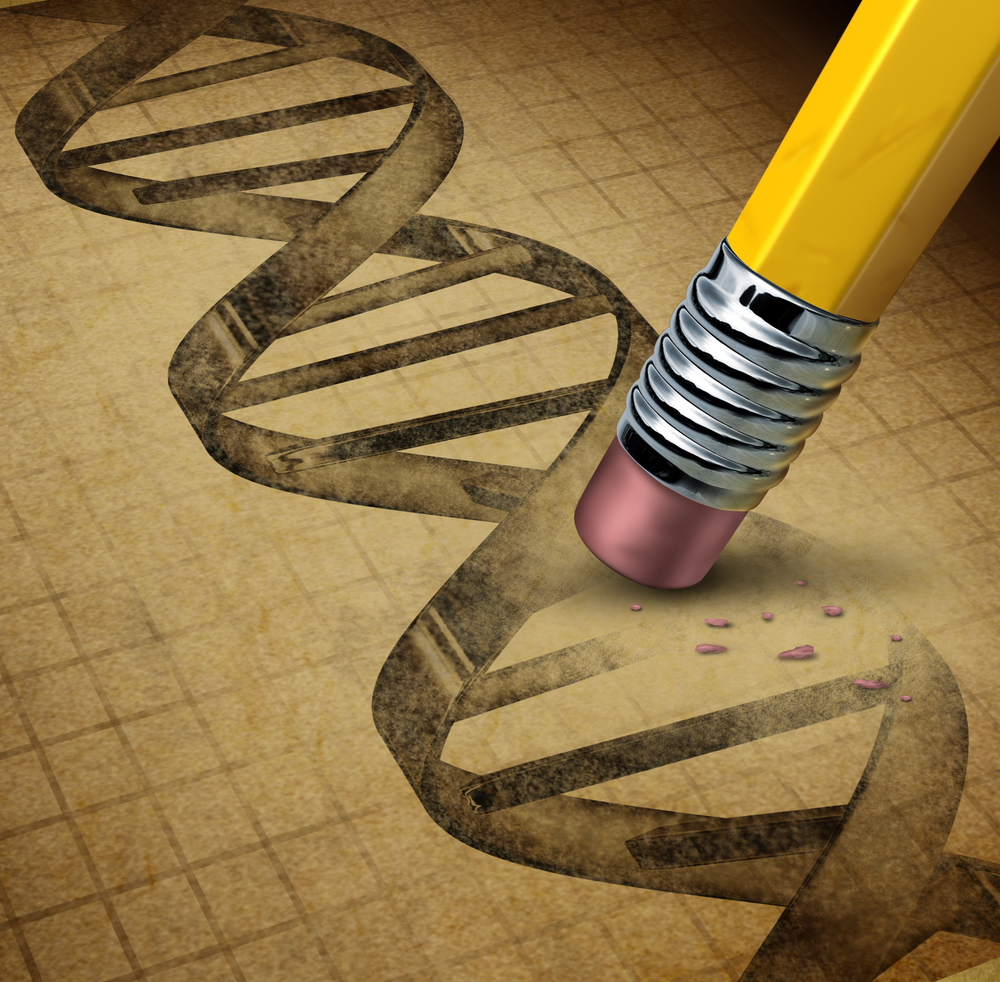
Essentially, tools like TALENs and CRISPRCRISPR A system for editing DNA in precise ways enable scientists to edit DNA – cutting out undesired parts and inserting desired ones, just like using a word processor to fix up an ugly paragraph. While scientists have long been able to ‘paste’ DNA into a broken strand, they’ve lacked the tools to ‘cut’ the DNA wherever they like. Now they have them.
The obvious thing to do, at least in the case of Huntington’s disease, is to cut out some of the extra copies of the C-A-G repeat that cause the disease. Another possibility is to use the editing tools to snip out part of the mutant HD gene, rending it gibberish that is never turned into a protein.
“The most important limitation to using CRISPR and related genome editing approaches is delivery, delivery, delivery.”
The newest, and currently most talked about, DNA editing technology is called CRISPRCRISPR A system for editing DNA in precise ways. Using the CRISPRCRISPR A system for editing DNA in precise ways approach, scientists can steer a cutting complex anywhere in a person’s DNA and make a very precise snip.
If this sounds familiar, it’s because it’s a very similar approach to zinc finger nucleases (ZFNs), which we’ve written about before at HDBuzz. The difference between CRISPRs and ZFNs is that the targeting component of ZFNs is bulky and is artificially constructed in the lab, while CRISPRs are steered more precisely using small pieces of RNARNA the chemical, similar to DNA, that makes up the 'message' molecules that cells use as working copies of genes, when manufacturing proteins., hopefully providing more specific targeting.
CRISPRs to the rescue?
CRISPRCRISPR A system for editing DNA in precise ways hit the headlines recently because the UK’s Independent newspaper commissioned an opinion piece by Nobel-winning geneticist Craig Mello, who’s started using the technique in his lab. Scientists have been studying CRISPRCRISPR A system for editing DNA in precise ways since at least 2007. What’s changed in the past couple of years is that CRISPRCRISPR A system for editing DNA in precise ways has become increasingly sophisticated as a tool for manipulating genes in the lab.
There are several possible uses of this CRISPRCRISPR A system for editing DNA in precise ways technology, or indeed any ‘genome editingGenome Editing The use of zinc-finger nucleases to make changes in DNA. 'Genome' is a word for all the DNA we each have. approach‘. First, it is possible to imagine treating very early stage embryosembryo the earliest stage during the development of a baby, when it consists of just a few cells, or even fertilized eggs, growing in a dish in a fertility clinic. With this kind of approach it’s technically possible to produce babies with no mutant HD genes, and so no Huntington’s disease.
While exciting, this is already possible using simpler techniques like pre-implantation genetic diagnosisPre-implantation genetic diagnosis A technique for preventing HD from being passed to children. Eggs and sperm are combined in a laboratory, and the embryos are tested genetically for the mutation. Only embryos without it are implanted into the mother's womb., which relies on a simple genetic screen to identify embryosembryo the earliest stage during the development of a baby, when it consists of just a few cells that carry the HD mutation. Genome editingGenome Editing The use of zinc-finger nucleases to make changes in DNA. 'Genome' is a word for all the DNA we each have. would take this one step further, and actually correct the defect, rather than simply screening for it.
Another exciting possible application of this technology would be to treat the brains of adult HD mutation carriers with something like CRISPRCRISPR A system for editing DNA in precise ways, targeting their mutant HD gene for correction. This use is the one which has caused so much speculation in the press – could we use these new genome editingGenome Editing The use of zinc-finger nucleases to make changes in DNA. 'Genome' is a word for all the DNA we each have. tools to correct the actual defect that causes genetic diseases, like HD?
What’s already happening?
In fact, as we reported in 2012, testing genome editingGenome Editing The use of zinc-finger nucleases to make changes in DNA. 'Genome' is a word for all the DNA we each have. for Huntington’s disease is already well underway! A company called Sangamo Biosciences is working with CHDI Foundation, Inc. to develop zinc finger nucleases as therapies for HD. They’ve already developed ZFNs that specifically bind and snip near the expanded C-A-G tract in the HD gene, which results in the interruption of HD gene expression.
This week, at the Society for Neuroscience meeting in San Diego, CA, Sangamo presented the latest results with ZFNs targeting the HD gene. Sangamo’s current efforts focus on silencing the gene, rather than editing it directly. For the first time, they described work suggesting that their ZFNs were beneficial in a mouse model of HD. Their press release notes that “in the ZFP Therapeutic-treated regions of the animals’ brains, scientists observed a reduction of mutant huntingtin proteinhuntingtin protein The protein produced by the HD gene. aggregatesaggregate Lumps of protein that form inside cells in Huntington’s disease and some other degenerative diseases”. They go on to say that mice treated in this way showed some improvements in behavioral signs of disease.

What’s hope and what’s hype?
Genome editingGenome Editing The use of zinc-finger nucleases to make changes in DNA. 'Genome' is a word for all the DNA we each have. technologies like CRISPRCRISPR A system for editing DNA in precise ways and ZFNs are amongst the most exciting lab advances of the last few years. Their potential use in both the lab and clinic is likely to be huge, but we need to consider the limitations to their use in Huntington’s disease.
The most important limitation to using CRISPRCRISPR A system for editing DNA in precise ways and related genome editingGenome Editing The use of zinc-finger nucleases to make changes in DNA. 'Genome' is a word for all the DNA we each have. approaches is delivery, delivery, delivery. Because these therapies are based on big protein molecules, they’re not the type of drug you can take in a pill: they have to be delivered into the brain using injections, packaged into viruses, or similar technology.
For example, if you look back to the Sangamo press release about ZFNs in HD mouse models, they’re careful to state that there was an improvement of aggregatesaggregate Lumps of protein that form inside cells in Huntington’s disease and some other degenerative diseases in “ZFP Therapeutic-treated regions of the animals’ brains”. This is likely to be a small proportion of the mouse brain, which would be a very tiny fraction of the human brain — unless we can drastically improve the delivery technology.
This type of therapy that involves the delivery of a gene to patients tissues is called gene therapy. Any gene therapy for HD will require brain surgery to get the virus into the brain, and then will only spread to a small patch of brain tissue, at least using existing technology.
While the newer CRISPRCRISPR A system for editing DNA in precise ways technique might make things somewhat easier and more precise, it doesn’t come close to solving the delivery problem.
Thanks to these delivery issues, getting gene therapy to work for neurodegenerativeneurodegenerative A disease caused by progressive malfunctioning and death of brain cells (neurons) diseases is going to be a long slog. In Huntington’s disease we also have the problem that we may need to deliver the drug to the entire brain in order to fix all the symptoms of HD, not just little patches of it. This will likely prove relatively easy in a mouse, whose brain weighs less than half a gram, but will be much harder in humans, whose brains are on the order of 1300 grams.
For Huntington’s disease patients, these new technologies remain an interesting lab technique — and one well worth pursuing — but until someone demonstrates that they can cover enough of the brain to make a difference, they won’t make the leap to human use. However, repairing the genomes of people with genetic diseases may well become a standard treatment some time in the future, and it’s very exciting to see the first steps down that long path.
Learn more
Sources & References
For more information about our disclosure policy see our FAQ…