
A Fault In The Supercomputer
⏱️ 8 min read | Your brain is an advanced supercomputer. But in HD, a core processor starts to malfunction. A research group at UCLA has taken a close look to visualize the specific circuits going haywire – and how they look different in HD.
Your brain is the most advanced supercomputer in the world. But in Huntington’s disease (HD), a core processor of this computer starts to malfunction. Using advanced imaging techniques, a research group at UCLA has taken a close look to identify and visualize the specific circuits going haywire in the parts of the brain most impacted by HD – and how the disease causes them to look different. They found that the specific circuits of a central brain region (the striatum) that are affected in HD, called medium spiny neuronsneuron Brain cells that store and transmit information, are less connected and less spiny than they should be.
The most complex computer in the world
The most complex computer in the world is not made of microchips – it’s sitting right inside your head. Although the fastest supercomputers rival the human brain for raw computational power, nothing can match the extraordinary flexibility and efficiency of your brain.
Just to give you a rough idea, the most powerful supercomputer right now, named “El Capitan” in California, crams cutting-edge equipment across the area of two tennis courts and takes up the energy of a small town. The brain is only about the size of a grapefruit and runs on the energy of a dim lightbulb, yet miraculously achieves the same computing capacity. Not to mention that El Capitan can’t dance, sing, catch a ball, or countless other amazing things your brain can do!
Clearly it’s worth understanding how this incredible computer in your head works, and also how it malfunctions in HD. So what part of this computer is affected in HD, and how can we understand what’s going wrong? A cutting-edge research group at UCLA has applied some inventive approaches to answer these questions.
A central computing malfunction in HD

The brain is not quite like a computer made of microchips, but there are some similarities. For one thing, the brain processes information through inputs and outputs. This processing happens using specialized cells called neuronsneuron Brain cells that store and transmit information, which operate a bit like circuits in a microchip. And like a computer, the brain is organized into different parts that process different things.
The brain has an incredible 86 billion neuronsneuron Brain cells that store and transmit information and just as many supporting cells, which together is about as many cells as there are stars in the Milky Way Galaxy. The scale of what your brain can do with all these brain cells is truly astounding. El Capitan comes nowhere close.
One of the most important parts of our amazing computer is a central region of the brain called the striatum, which is further divided into the caudate and putamenputamen part of the striatum, a deep brain region important for movement control, that's affected early in the course of HD..
You can think of the striatum as Grand Central Station for many brain processes – a place where many circuits connect to. The striatum is one of the most affected parts of the brain in HD, which is why symptoms of HD can be so diverse, including uncontrolled movements, mood problems, and difficulty thinking. So to understand HD, you have to understand the striatum.
A special kind of circuit is affected in HD
Some parts of the brain have dozens and dozens of different kinds of neuronsneuron Brain cells that store and transmit information, but fortunately the neuronsneuron Brain cells that store and transmit information found in the striatum are not as diverse as in other parts of the brain. This makes the striatum a bit easier to understand.
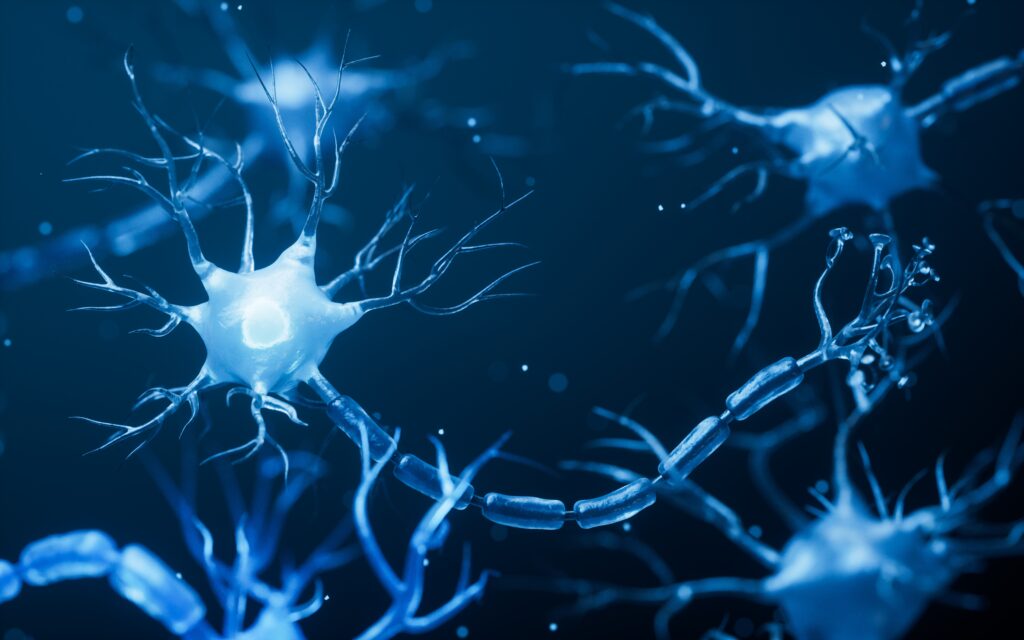
You can think of the striatum like a processing cluster in your computer, with many circuits that are similar to each other. These circuits in the striatum are called medium spiny neuronsneuron Brain cells that store and transmit information, and they represent most of the neuronsneuron Brain cells that store and transmit information found there. “Medium spiny neuronneuron Brain cells that store and transmit information” might seem like a made-up name but that’s really what scientists call them, because of how they look! They are medium sized and very spiny. You may have also seen them called MSNs for short.
Why are medium spiny neuronsneuron Brain cells that store and transmit information so spiny? That’s because each medium spiny neuronneuron Brain cells that store and transmit information receives signals from many other neuronsneuron Brain cells that store and transmit information in the brain, and each of these inputs happens through a little spine that sticks out from the medium spiny neuronneuron Brain cells that store and transmit information. Medium spiny neuronsneuron Brain cells that store and transmit information have many inputs, so that’s why they have many spines. It’s Grand Central Station for the brain, remember?
Medium spiny neuronsneuron Brain cells that store and transmit information are clearly very important, but we don’t know exactly how they are individually connected to the rest of the brain, just that they have many inputs. It’s medium spiny neuronsneuron Brain cells that store and transmit information that are particularly vulnerable in HD, which scientists think causes the striatum to malfunction and cause the symptoms of HD.
Mapping out the circuits in three dimensions
Surprisingly, very little research has been done on what medium spiny neuronsneuron Brain cells that store and transmit information look like, apart from them being spiny. Do they all look the same? How do they look when they are damaged in HD? A renowned research group at UCLA led by Dr. X. William Yang decided to map out what medium spiny neuronsneuron Brain cells that store and transmit information look like in the brain, and what happens to them in HD.
To do this, the group labeled medium spiny neuronsneuron Brain cells that store and transmit information so they glow under a microscope, and also labeled each spine – called dendritic spines, or simply dendrites. They could not do this labeling in human brains, so instead they did this in mouse brains that also have a striatum. After labeling the medium spiny neuronsneuron Brain cells that store and transmit information and their spines (dendrites), they sliced the striatum into slabs and took detailed images of each slab to see what the medium spiny neuronsneuron Brain cells that store and transmit information looked like.
This is sort of like slicing a dense Jell-O mold with small fruits scattered inside, so you can more easily see the fruit. This allowed the researchers to see what the medium spiny neuronsneuron Brain cells that store and transmit information looked like in three dimensions within each slice. Remarkably, this is the first time anyone has looked at medium spiny neuronsneuron Brain cells that store and transmit information in this way! So what did they see?
Not all circuits look the same
The striatum is actually divided into further processing clusters, even though they all have medium spiny neuronsneuron Brain cells that store and transmit information that are affected in HD. So the researchers decided to assess what medium spiny neuronsneuron Brain cells that store and transmit information look like across these different clusters.
They measured all kinds of variables about the medium spiny neuronsneuron Brain cells that store and transmit information, like how many spines they have, how long they are, and how frequently spines branch into smaller spines. This is a bit like looking at the circuits in a specific part of a computer, and studying how long each of the circuits are and where they go.
Interestingly, medium spiny neuronsneuron Brain cells that store and transmit information look a bit different in different parts of the striatum. In some parts of the striatum the spines are longer than others, in other parts they are shorter. In some parts of the striatum the spines are more numerous, and in some parts they are more branched. Clearly there’s a lot more going on with how these medium spiny neuronsneuron Brain cells that store and transmit information are wired in the striatum than we previously knew.
In HD, fewer circuit connections than there should be

Medium spiny neuronsneuron Brain cells that store and transmit information of the striatum are especially vulnerable in HD, and start to malfunction and disappear very early in the disease. So what did the scientists observe about the shape and appearance of these different medium spiny neuronneuron Brain cells that store and transmit information circuits in HD?
To study this, they did the same labeling, brain slicing, and microscope imaging, but this time in a mouse that models HD with an expanded CAG repeatCAG repeat The stretch of DNA at the beginning of the HD gene, which contains the sequence CAG repeated many times, and is abnormally long in people who will develop HD. Intriguingly, medium spiny neuronsneuron Brain cells that store and transmit information in the HD mice were less complex, and had fewer branches.
This suggests that in HD, there may be fewer circuit connections than there should be between medium spiny neuronsneuron Brain cells that store and transmit information and the rest of the brain. In other words, the malfunction of the striatum in HD may be related to lower connectivity with the rest of the brain, like a processing core losing connections to the rest of the computer.
Understanding how neuronsneuron Brain cells that store and transmit information that are affected in HD lose their connections with the rest of the brain is critically important for understanding how to repair them, or stop them from malfunctioning in the first place. With more studies like these, we can develop better ways to track and treat the causes of HD in the future.
Summary
- Your brain is the most complex computer in the world
- HD causes a specific part of this computer, the striatum, to malfunction
- Specific circuits in the striatum, called medium spiny neuronsneuron Brain cells that store and transmit information, seem to be lost in HD
- The research suggests that medium spiny neuronsneuron Brain cells that store and transmit information have slightly different appearance and connections across different parts of the striatum
- Medium spiny neuronsneuron Brain cells that store and transmit information appear to be less complex in HD and have fewer connections
Sources & References
For more information about our disclosure policy see our FAQ…