
Energy off balance: How Huntington’s disease influences the cell’s powerhouse
Scientists used 3D mini-brains grown from stem cells to study Huntington’s disease. They found early developmental changes linked to mitochondrial stress, suggesting that energy imbalance may play a role in HD, even before neurons fully form.
A recent study used miniature 3D brain models grown from stem cellsstem cells Cells that can divide into cells of different types to explore how the genetic change that causes Huntington’s disease (HD) might impact early brain development, before neuronsneuron Brain cells that store and transmit information even become neuronsneuron Brain cells that store and transmit information. What they found suggests that the tipping point that balances how cells mature may be off, and it could be because of changes in the cell’s energy powerhouse – the mitochondriamitochondria tiny machines inside our cells that process fuel into energy, enabling cells to function. Let’s get into what they found, the major takeaways, and next steps.
Growing A ‘Mini-Brain’ In A Dish
You may have heard of ‘stem cellsstem cells Cells that can divide into cells of different types’ – cells that can be coaxed into becoming almost any cell type in the body, including neuronsneuron Brain cells that store and transmit information. Stem cellsstem cells Cells that can divide into cells of different types have been transformative for brain diseases like HD. They’re a powerful laboratory tool because they allow researchers to ask and answer questions in a controlled system of human origin, which is key for understanding the impact of HD in people.
This powerful system was further advanced with the discovery of ‘induced pluripotent stem cellsinduced pluripotent stem cells Stem cells that have been grown from adult cells.’, or iPSCs. iPSCs are produced through a method that adds molecules to turn adult cells, like skin cells, back into stem cellsstem cells Cells that can divide into cells of different types. Using this approach, new work is advancing what we know about HD.
One limitation of neuronsneuron Brain cells that store and transmit information grown from stem cellsstem cells Cells that can divide into cells of different types is that they’re typically grown on a two-dimensional plastic surface. Not very representative of the human brain! To overcome this challenge, researchers have developed a method to grow iPSCs in 3D, producing ‘mini-brains’ that resemble specific brain regions.
Importantly, even though they’re referred to as mini-brains, they can’t develop consciousness nor can they be grown into a full human brain. Scientists like working with them because they have been shown to recapture key aspects of human brain development and are especially useful for studying developmentally early biological changes.
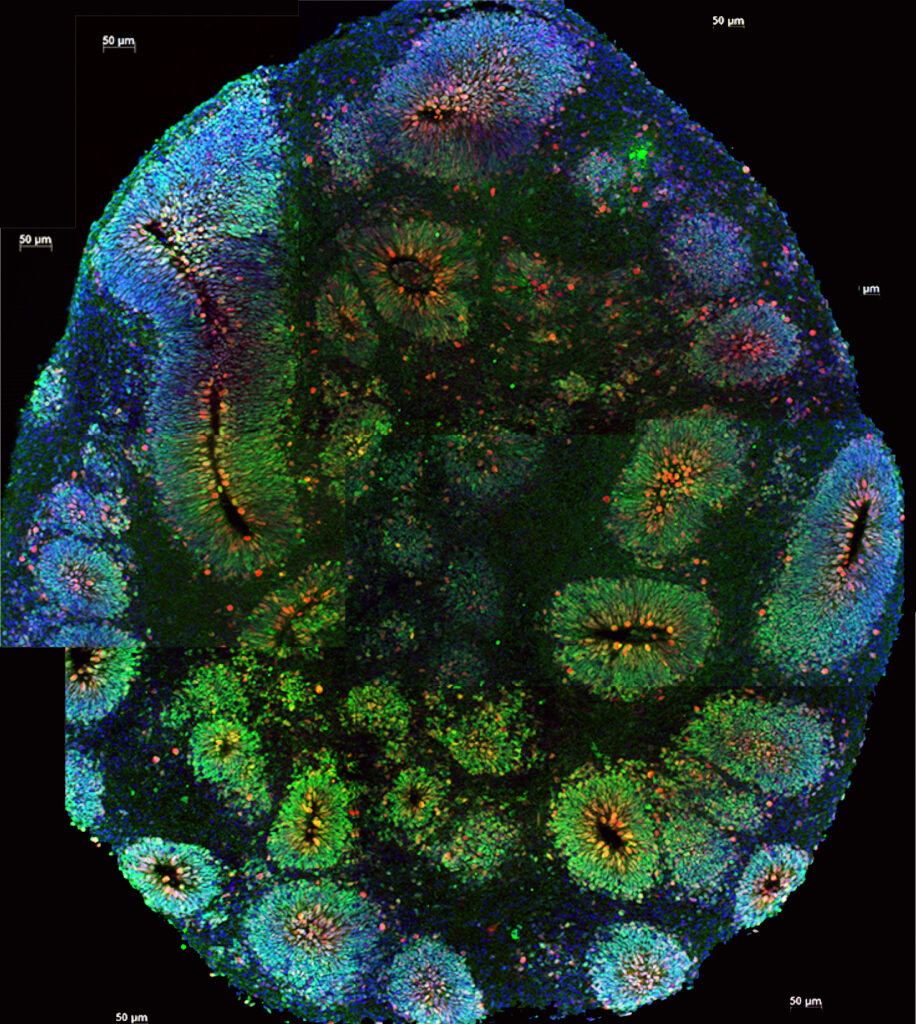
Creative Commons – Vaccarino Lab, Yale University
The HTTHTT one abbreviation for the gene that causes Huntington’s disease. The same gene is also called HD and IT-15 Gene – Important For Brain Development
In studying brain development, researchers discovered long ago that the huntingtin gene, HttHTT one abbreviation for the gene that causes Huntington’s disease. The same gene is also called HD and IT-15, plays an important role – mice that lack the HttHTT one abbreviation for the gene that causes Huntington’s disease. The same gene is also called HD and IT-15 gene do not survive as embryosembryo the earliest stage during the development of a baby, when it consists of just a few cells. Using genetic experiments, scientists figured out that this was because of brain development changes; mice that had HttHTT one abbreviation for the gene that causes Huntington’s disease. The same gene is also called HD and IT-15 levels specifically lowered only in the brain failed to develop healthy brains.
A recent study sought to clarify how brain development is altered by HD in cells of human origin using mini-brains. They used iPSCs with 70 CAG repeats, which usually leads to the onset of juvenile HDjuvenile HD Huntington's disease where symptoms begin before the age of 20.. This is important because individuals with juvenile HDjuvenile HD Huntington's disease where symptoms begin before the age of 20. show unique symptoms compared to adult-onset HD. These symptoms are associated with disorders where early brain development is affected, like seizures.
Genetic Changes In HD Mini-Brains
When the researchers grew mini-brains with and without the gene that causes HD, they noticed that those with the HD gene were smaller in size than those grown from cells without the CAG expansion. When they dug into this, it appeared to be due to defects before the neuronsneuron Brain cells that store and transmit information themselves were fully formed. Specifically, these changes were found in ‘neural progenitor cells’ – precursor cells that turn into nerve cells.
Similar disruptions of neural progenitor cells have been reported in human foetuses with a CAG expansion. These findings suggest that changes due to the HD gene seem to have a role in the development of the brain. And because those changes are seen in progenitor cells that are precursors for neuronsneuron Brain cells that store and transmit information, the HD gene specifically seems to contribute to changes in early brain development, before neuronsneuron Brain cells that store and transmit information are actually formed.
The researchers went one step further, trying to understand what is causing this disruption. The study looked at different gene signatures between iPSCs, neural progenitor cells, and mini-brains at two different ‘ages’, with and without the gene for HD. They found that 47 genes levels were changed across all samples. The gene that was lowered the most in all HD samples was CHCHD2 which stands for ‘coiled-coil-helix-coiled-coil-helix domain containing 2’ – what a mouthful! You can see why scientists prefer CHCHD2.
A recent study sought to clarify how brain development is altered by HD in cells of human origin using mini-brains.
The Powerhouse Of The Cell – HTTHTT one abbreviation for the gene that causes Huntington’s disease. The same gene is also called HD and IT-15 Changes How The Cells Use Energy
CHCHD2 plays a crucial role in the health of mitochondriamitochondria tiny machines inside our cells that process fuel into energy, enabling cells to function, the powerhouse of the cell. Mitochondriamitochondria tiny machines inside our cells that process fuel into energy, enabling cells to function generate most of the energy that a cell needs to function. Because mitochondriamitochondria tiny machines inside our cells that process fuel into energy, enabling cells to function are so important for the cell, they frequently undergo rigorous ‘quality control’, where damaged mitochondriamitochondria tiny machines inside our cells that process fuel into energy, enabling cells to function are degraded within the cell. Mitochondriamitochondria tiny machines inside our cells that process fuel into energy, enabling cells to function can become damaged or ‘stressed’ under many different circumstances, for example when a cell needs a lot of energy, becomes sick, or is exposed to toxins.
CHCHD2 is involved in how mitochondriamitochondria tiny machines inside our cells that process fuel into energy, enabling cells to function respond to stress, and in HD neural progenitor cells and mini-brains, other genes involved in mitochondriamitochondria tiny machines inside our cells that process fuel into energy, enabling cells to function stress responses were also found at unexpected levels. Essentially, the research team seemed to identify a stress response related to mitochondriamitochondria tiny machines inside our cells that process fuel into energy, enabling cells to function caused by HD that’s present even at very early stages of development. Ultimately, this could be damaging for cells and impact the way the brain develops.
Mitochondriamitochondria tiny machines inside our cells that process fuel into energy, enabling cells to function form complex networks within the cell and are also very active. They can divide to generate more mitochondriamitochondria tiny machines inside our cells that process fuel into energy, enabling cells to function during stress, or they can fuse to optimise energy production. To study these networks, the researchers used microscopes to look at the shape of the mitochondriamitochondria tiny machines inside our cells that process fuel into energy, enabling cells to function.
They found that mitochondriamitochondria tiny machines inside our cells that process fuel into energy, enabling cells to function shape in HD mini-brains was different – some mitochondriamitochondria tiny machines inside our cells that process fuel into energy, enabling cells to function were more fragmented, but others formed very large structures. While mitochondriamitochondria tiny machines inside our cells that process fuel into energy, enabling cells to function can change their shape in a healthy cell too, it can also be a further indicator that these cells may be damaged or stressed. In older mini-brains, these changes in shape became worse, suggesting that defects in mitochondriamitochondria tiny machines inside our cells that process fuel into energy, enabling cells to function increase over time and that the quality control system behind keeping mitochondriamitochondria tiny machines inside our cells that process fuel into energy, enabling cells to function in check could be impaired by HD.
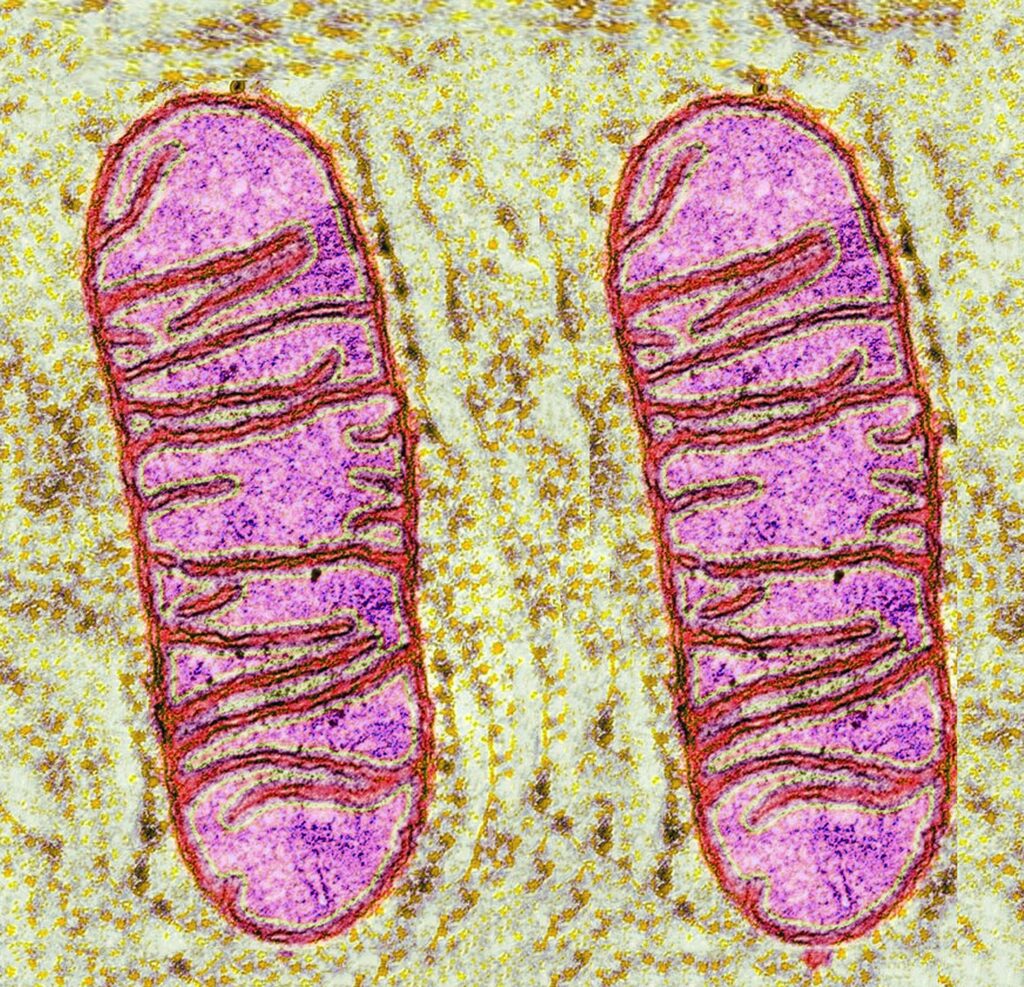
Cells Need More Energy In HD
A big implication here is that the change in mitochondriamitochondria tiny machines inside our cells that process fuel into energy, enabling cells to function networks and shape could have an impact on how mitochondriamitochondria tiny machines inside our cells that process fuel into energy, enabling cells to function generate energy for the cell. To understand this better, the researchers investigated how the neural progenitor cells utilise energy. In cells with the CAG expansion, more energy was used under ‘resting conditions’. This means that mitochondriamitochondria tiny machines inside our cells that process fuel into energy, enabling cells to function could have to provide more energy for the cell. HD mitochondriamitochondria tiny machines inside our cells that process fuel into energy, enabling cells to function also showed changes in the way they produced energy for the cell.
The team then examined whether these defects are specific for the less mature progenitor cells or if they’re also present in neuronsneuron Brain cells that store and transmit information. Interestingly, they found that mitochondriamitochondria tiny machines inside our cells that process fuel into energy, enabling cells to function in HD neuronsneuron Brain cells that store and transmit information generated less energy for the cell but used more energy themselves.
And all of these effects seem to hinge on CHCHD2, because when the scientists boosted its levels in the mini-brains, the changes in mitochondriamitochondria tiny machines inside our cells that process fuel into energy, enabling cells to function shape and function were erased. This suggests that if these results are also seen in other models of HD, CHCHD2 could be a potential therapeutic target for improving mitochondriamitochondria tiny machines inside our cells that process fuel into energy, enabling cells to function changes.
Essentially, the research team seemed to identify a stress response related to mitochondria caused by HD that’s present even at very early stages of development. Ultimately, this could be damaging for cells and impact the way the brain develops.
Takeaways And Next Steps
Overall, the results in the paper suggest that the HD gene may stress mitochondriamitochondria tiny machines inside our cells that process fuel into energy, enabling cells to function, cause inefficient repair, and change the way they produce energy for cells, even in early brain development.
An important caveat to this work is that most of the results were from cells where both copies of the HttHTT one abbreviation for the gene that causes Huntington’s disease. The same gene is also called HD and IT-15 gene had the CAG expansion. This is very rare in people with HD and future work is needed to see if the results hold in models with just one copy of the HD gene.
One of the reasons this work is important is because mitochondriamitochondria tiny machines inside our cells that process fuel into energy, enabling cells to function health and function in neural progenitor cells helps regulate the pace of development – orchestrating balance between which cells remain progenitors and which cells mature into neuronsneuron Brain cells that store and transmit information. Cells that commit to staying a progenitor or becoming a neuronneuron Brain cells that store and transmit information on an altered timeline may be more sensitive to cellular stress in the future, contributing to their death in HD.
This perhaps suggests that findings from this paper could help define the tipping point of developmental changes in the brain caused by HD. While more work is needed to see how these results hold beyond cells grown in a dish, this study highlights that mitochondriamitochondria tiny machines inside our cells that process fuel into energy, enabling cells to function and energy production could be an early therapeutic target to consider.
TL;DR – What You Really Need To Know
- Scientists used 3D “mini-brains” from stem cellsstem cells Cells that can divide into cells of different types to model early brain development changes in HD.
- HD mini-brains were smaller and showed defects before neuronsneuron Brain cells that store and transmit information fully formed.
- Changes were found in neural progenitor cells, the brain’s early builders.
- A key energy-related gene, CHCHD2, was reduced in HD models, disrupting mitochondriamitochondria tiny machines inside our cells that process fuel into energy, enabling cells to function (the cell’s powerhouse!).
- HD cells burned more energy at rest and had oddly shaped, stressed mitochondriamitochondria tiny machines inside our cells that process fuel into energy, enabling cells to function.
- Boosting CHCHD2 reversed the problems, pointing to a possible new treatment target.
Learn More
For more information about our disclosure policy see our FAQ…