
Fixing the Recipe: Lowering a Slice of Huntingtin
⏱️7 min read | In a recent paper, scientists targeted a small, harmful piece of the huntingtin message (HTT1a) in HD mice. This reduced toxic protein clumps and delayed genetic changes, more than targeting full length HTT.
A new study shows that lowering a harmful piece of the huntingtin message (Htt1a) appears effective at reducing HD-related symptoms in mice, perhaps more so than targeting full length HTTHTT one abbreviation for the gene that causes Huntington’s disease. The same gene is also called HD and IT-15. Whether lowering HTT1a in people has the same effect remains to be seen but studies in mice like this open up new ideas about HTTHTT one abbreviation for the gene that causes Huntington’s disease. The same gene is also called HD and IT-15 lowering. Let’s get in this study.
What are RNARNA the chemical, similar to DNA, that makes up the 'message' molecules that cells use as working copies of genes, when manufacturing proteins. transcripts?
Your body works by following a simple flow of genetic information. Back in 1957, Francis Crick described this as the fundamental process of biology: DNA replicates itself and serves as a template to create RNARNA the chemical, similar to DNA, that makes up the 'message' molecules that cells use as working copies of genes, when manufacturing proteins., and RNARNA the chemical, similar to DNA, that makes up the 'message' molecules that cells use as working copies of genes, when manufacturing proteins. is then used to make proteins. RNARNA the chemical, similar to DNA, that makes up the 'message' molecules that cells use as working copies of genes, when manufacturing proteins. messages – known as transcripts – are molecules used as instructions to make proteins. Think of DNA as the written individual ingredients, RNARNA the chemical, similar to DNA, that makes up the 'message' molecules that cells use as working copies of genes, when manufacturing proteins. as the recipe, and proteins as the completed meal.
Scientists are especially interested in RNARNA the chemical, similar to DNA, that makes up the 'message' molecules that cells use as working copies of genes, when manufacturing proteins. when it comes to treating diseases with known genetic causes. Instead of trying to get rid of harmful proteins after they’ve already been made, it can be more effective to stop them from being made in the first place. This involves targeting the RNARNA the chemical, similar to DNA, that makes up the 'message' molecules that cells use as working copies of genes, when manufacturing proteins. molecules before they’re ever used to make proteins.
This idea is particularly important for Huntington’s disease (HD), as researchers are exploring ways to target the RNARNA the chemical, similar to DNA, that makes up the 'message' molecules that cells use as working copies of genes, when manufacturing proteins. that carries the instructions for making huntingtin (HTTHTT one abbreviation for the gene that causes Huntington’s disease. The same gene is also called HD and IT-15), with the goal of producing less of the toxic protein and thus improving symptoms.
HTT1a: A toxic fragment
HD is caused by an expanded repeated section of the DNA letters C-A-G in the HTTHTT one abbreviation for the gene that causes Huntington’s disease. The same gene is also called HD and IT-15 gene. This expanded gene produces an abnormal version of the HTTHTT one abbreviation for the gene that causes Huntington’s disease. The same gene is also called HD and IT-15 protein, with an extra-long segment that causes it to fold incorrectly. Instead of doing its normal job, the misfolded protein becomes sticky and starts clumping together, damaging neuronsneuron Brain cells that store and transmit information and hastening symptoms. Think of it like following a key lime pie recipe where one instruction is accidentally repeated over and over: adding one teaspoon of salt makes it tasty, but an extra twenty will ruin the pie.
But that’s not the whole story. The genetic mutation doesn’t just affect the final protein – it can also interfere with how the gene’s instructions (messenger RNAmessenger RNA A message molecule, based on DNA, used by cells as the final set of instructions for making a protein., or mRNAmessenger RNA A message molecule, based on DNA, used by cells as the final set of instructions for making a protein.) are made. Sometimes, the instructions are cut off early, which produces a shorter version of the HTTHTT one abbreviation for the gene that causes Huntington’s disease. The same gene is also called HD and IT-15 message called HTT1a. This creates a tiny and potentially harmful version of the huntingtin proteinhuntingtin protein The protein produced by the HD gene.. This shorter HTT1a protein clumps together even more easily and potentially causing more toxicity in brain cells. Imagine that alongside adding salt repeatedly, your recipe includes whole limes (peel and all) along with lime juice. At that point, the entire pie is inedible!
All of this might sound like a recipe for disaster, but it also points to a possible solution. Instead of trying to fix the final, damaged product, researchers are going straight to the source: mRNAmessenger RNA A message molecule, based on DNA, used by cells as the final set of instructions for making a protein., the recipe itself.

siRNAsiRNA A way of silencing genes using specially designed molecules of RNA – like DNA but made of only a single strand – that target the message molecules in cells and tell them not to make a certain protein: Biology’s eraser
siRNAsiRNA A way of silencing genes using specially designed molecules of RNA – like DNA but made of only a single strand – that target the message molecules in cells and tell them not to make a certain protein, or small-interfering RNARNA the chemical, similar to DNA, that makes up the 'message' molecules that cells use as working copies of genes, when manufacturing proteins., is a tool that scientists use to reduce the amount of mRNAmessenger RNA A message molecule, based on DNA, used by cells as the final set of instructions for making a protein. in a cell. By targeting and breaking down specific mRNAmessenger RNA A message molecule, based on DNA, used by cells as the final set of instructions for making a protein., siRNAsiRNA A way of silencing genes using specially designed molecules of RNA – like DNA but made of only a single strand – that target the message molecules in cells and tell them not to make a certain protein effectively prevents certain proteins from being produced. If mRNAmessenger RNA A message molecule, based on DNA, used by cells as the final set of instructions for making a protein. is the recipe for a dish, siRNAsiRNA A way of silencing genes using specially designed molecules of RNA – like DNA but made of only a single strand – that target the message molecules in cells and tell them not to make a certain protein acts like a pencil that erases some ingredient words so that you just have to skip them. Without all the extra tablespoons of salt and the whole limes, your pie will turn out as planned (hopefully delicious).
It is still unclear whether targeting full-length HTTHTT one abbreviation for the gene that causes Huntington’s disease. The same gene is also called HD and IT-15, HTT1a, or both might improve HD outcomes in people. There are currently multiple drugs in development that use these different methods: AMT-130 (uniQure), ALN-HTT2 (Alnylam), and V0659 (Vico) target both full-length HTTHTT one abbreviation for the gene that causes Huntington’s disease. The same gene is also called HD and IT-15 and HTT1a, whereas tominersen (Roche), votoplam (Novartis), and SKY-0515 (Skyhawk) likely target only full-length HTTHTT one abbreviation for the gene that causes Huntington’s disease. The same gene is also called HD and IT-15. Tominersen is the only HTTHTT one abbreviation for the gene that causes Huntington’s disease. The same gene is also called HD and IT-15-lowering therapeutic that has been evaluated in an advanced (Phase 3) clinical trialclinical trial Very carefully planned experiments designed to answer specific questions about how a drug affects human beings which is looking for how the drug might alter symptoms in hundreds of people. Although it did not show any benefit in the complete cohortcohort a group of participants in a clinical research study dataset, there were signs of improvement in some participants, so the community is waiting for the results of the next Phase 3 trial currently underway for this drug.
What was investigated?
A study published last month explores whether siRNAs that target full-length HTTHTT one abbreviation for the gene that causes Huntington’s disease. The same gene is also called HD and IT-15 or HTT1a transcripts can improve signs of HD in mouse models, and whether targeting one, the other, or both works best. In an earlier study by the same group of researchers, they reduced levels of these genetic messages by genetically altering the mice. However, using an injectable drug has greater potential for how this might pan out in real-world use in people.
The researchers designed two siRNAs – one that targets full-length HTTHTT one abbreviation for the gene that causes Huntington’s disease. The same gene is also called HD and IT-15, and one targeting HTT1a. After confirming that these siRNAs work, they injected them into the brains of mice that model HD. In HD research, different types of HD mice are used depending on the features that they have. The one they used in this study has some features that mimic those people of HD that progress over time, like the appearance of HTTHTT one abbreviation for the gene that causes Huntington’s disease. The same gene is also called HD and IT-15 aggregatesaggregate Lumps of protein that form inside cells in Huntington’s disease and some other degenerative diseases, especially in the nucleusnucleus A part of the cell containing genes (DNA) of brain cells, and dysfunction in how networks of genes turn on and off. To evaluate how effective this approach was, researchers designed an interventionalinterventional A study in which an experimental drug or treatment is given to volunteers study and organized the mice into three main groups:
- Early group: injected in the very earliest stages of disease (2 months old) and analyzed as signs and symptoms were worsening (6 months)
- Double group: injected in the early and middle stages of disease (2 and 6 months) and analyzed at the peak of symptoms (10 months)
- Late group: injected in the middle stage of disease (6 months) and analyzed at the peak of symptoms (10 months)
These groups were compared to see whether earlier treatment, later treatment, or repeated dosing led to better outcomes.
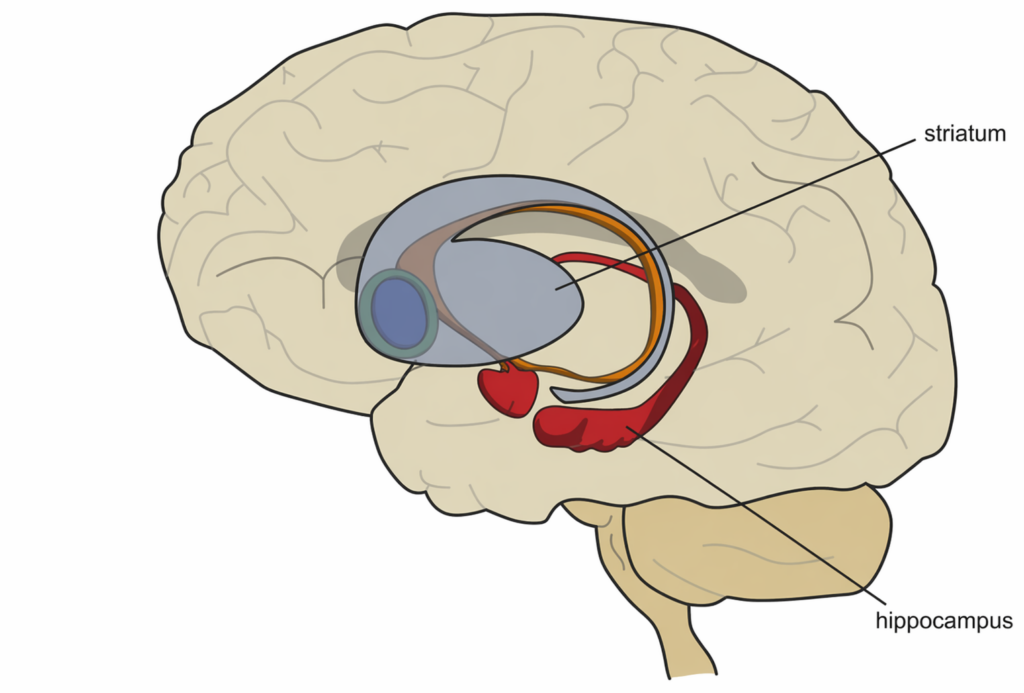
Highlighting the hippocampushippocampus the seahorse-shaped part of the brain that's crucial for memory
After injecting each mouse cohortcohort a group of participants in a clinical research study with the siRNAs designed to target full length HttHTT one abbreviation for the gene that causes Huntington’s disease. The same gene is also called HD and IT-15 or Htt1a, they waited several months and measured the amount of HTTHTT one abbreviation for the gene that causes Huntington’s disease. The same gene is also called HD and IT-15 and HTT1a protein in different parts of the brain. Compared to untreated mice, they found that both were most effective in the hippocampushippocampus the seahorse-shaped part of the brain that's crucial for memory, the part of the brain that is responsible for emotion and memory.
This is not typically where HD pathology is studied; research usually focuses on the striatum, which primarily controls motor and executive functioning. Although the researchers did examine the striatum, they observed only modest reductions in HTTHTT one abbreviation for the gene that causes Huntington’s disease. The same gene is also called HD and IT-15 and no change in HTT1a levels. But HD affects the whole brain, and scientists often follow the data where it takes them! Because their findings led them to the hippocampushippocampus the seahorse-shaped part of the brain that's crucial for memory, it became the focus for the remainder of the study.
Lowering HTT1a seems to be more effective in mice that model HD – but timing is key
While both siRNAs reduced the protein in the hippocampushippocampus the seahorse-shaped part of the brain that's crucial for memory, targeting Htt1a seemed to have some additional benefit for one sign of HD: it delayed HTTHTT one abbreviation for the gene that causes Huntington’s disease. The same gene is also called HD and IT-15 protein clumping. There were fewer aggregatesaggregate Lumps of protein that form inside cells in Huntington’s disease and some other degenerative diseases formed, and for mice in the Double treatment group, aggregatesaggregate Lumps of protein that form inside cells in Huntington’s disease and some other degenerative diseases in the nucleusnucleus A part of the cell containing genes (DNA) did not appear at all. Overall, only the HTT1a treatment seemed to reduce both the amount and severity of the toxic protein accumulations in the hippocampushippocampus the seahorse-shaped part of the brain that's crucial for memory.
That said, both treatments had a positive effect on HD-related gene activity in mice within the Early and Double cohorts, though the Htt1a siRNAsiRNA A way of silencing genes using specially designed molecules of RNA – like DNA but made of only a single strand – that target the message molecules in cells and tell them not to make a certain protein seemed to have a more pronounced effect. However, the Late group showed little benefit of treatment and some signs of disease may even have worsened. Overall, the results suggest that this approach works best when given early, and appears to be less effective if started later in disease progression.
Why does this matter?
This study shows that the way full-length HTTHTT one abbreviation for the gene that causes Huntington’s disease. The same gene is also called HD and IT-15 and HTT1a proteins are involved in forming HTTHTT one abbreviation for the gene that causes Huntington’s disease. The same gene is also called HD and IT-15 aggregatesaggregate Lumps of protein that form inside cells in Huntington’s disease and some other degenerative diseases is complex and can differ depending on the type of brain cell involved (hippocampushippocampus the seahorse-shaped part of the brain that's crucial for memory versus striatum). However, most of the benefits seen in the experiments they conducted come from lowering HTT1a, which should be a consideration when designing HD therapeuticstherapeutics treatments. Overall, this suggests that future treatments may work best if they reduce both HTTHTT one abbreviation for the gene that causes Huntington’s disease. The same gene is also called HD and IT-15 and HTT1a, or if they are designed to specifically target HTT1a in humans.
Some caveats
As promising as these findings are, this study was conducted in mice, not people. HD mouse models develop disease over months rather than decades and often carry very large CAG expansions in every cell, which may lead them to produce more HTT1a than is typically seen in people with HD. This means HTT1a could play a larger role in these mice than it does in human disease. The strongest benefits were also seen in the hippocampushippocampus the seahorse-shaped part of the brain that's crucial for memory rather than the striatum, a brain region more closely linked to many HD symptoms. Future clinical studies will be needed to determine whether lowering HTT1a has similar benefits in people.
Summary
- In HD, faulty RNARNA the chemical, similar to DNA, that makes up the 'message' molecules that cells use as working copies of genes, when manufacturing proteins. can produce both the full huntingtin proteinhuntingtin protein The protein produced by the HD gene. and a shorter, potentially more toxic version called HTT1a, which might contribute to HTTHTT one abbreviation for the gene that causes Huntington’s disease. The same gene is also called HD and IT-15 toxicity and symptom onset.
- In this study, researchers developed siRNAsiRNA A way of silencing genes using specially designed molecules of RNA – like DNA but made of only a single strand – that target the message molecules in cells and tell them not to make a certain protein treatments that lowered HTTHTT one abbreviation for the gene that causes Huntington’s disease. The same gene is also called HD and IT-15 and HTT1a levels in mouse brains, reduced toxic protein clumping, and improved abnormal HD gene activity.
- Targeting HTT1a seemed to be more effective than targeting full-length HTTHTT one abbreviation for the gene that causes Huntington’s disease. The same gene is also called HD and IT-15 in mice that model HD by some measures, although lowering HTT1a and full-length HTTHTT one abbreviation for the gene that causes Huntington’s disease. The same gene is also called HD and IT-15 produced benefit by looking at other signs of HD in these models.
- Overall, the results suggest that reducing HTT1a could be important, but the jury is out on which approach might be better in people where the amount of HTT1a made is very different.
For more information about our disclosure policy see our FAQ…